
Old Delhi · India
Red Wall Split.
Old Delhi. My flight to Agra was cancelled, so I walked. He stood in his uniform, still, while the street moved around him. Kodak film, Leica M6, 35mm.

Quantum Memory investigates the transition of the documentary image from representation into material form. Using thermal sublimation, photographic dyes are embedded directly into vintage domestic textiles — cotton lace, linens, and fabrics that carry their own histories of labor and use.
Rather than functioning as surface reproductions, these works alter the substrate at a molecular level. The image becomes inseparable from the material that carries it. Domestic textiles — objects historically associated with care, labor, and inheritance — become structural carriers of memory.
The work operates as a material translation system. Documentary encounters migrate into physical substrates, where memory persists not as representation, but as embedded structure.
Old Delhi. My flight to Agra was cancelled, so I walked. He stood in his uniform, still, while the street moved around him. Kodak film, Leica M6, 35mm.
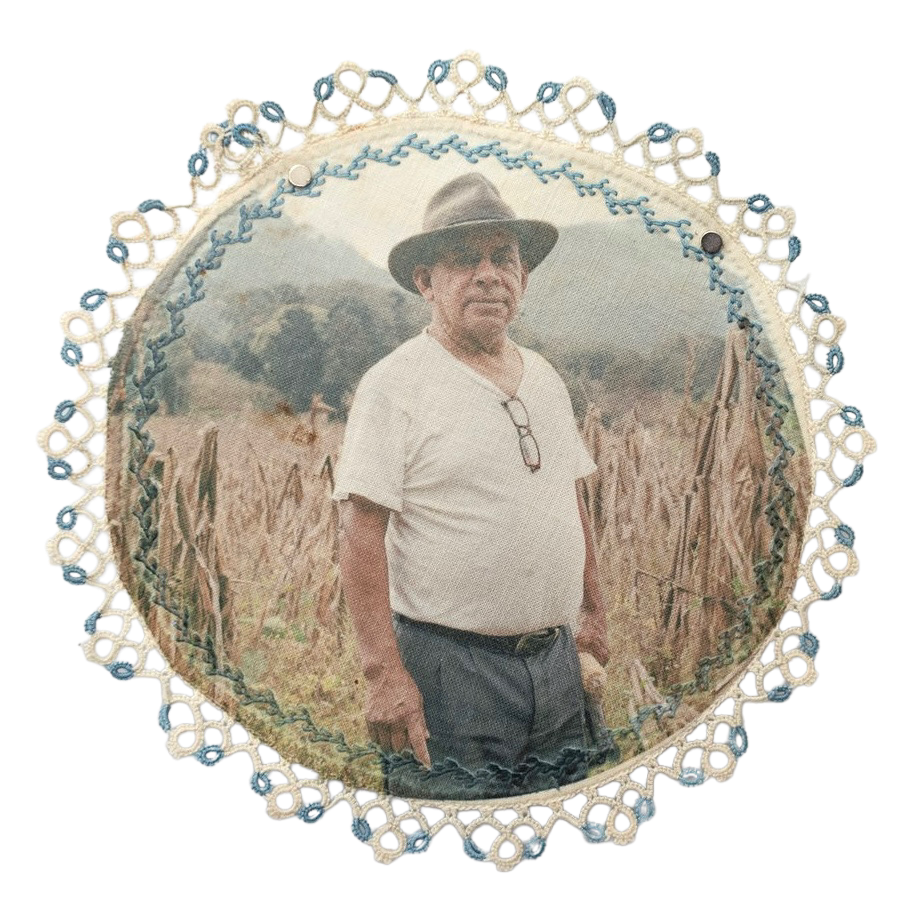
Guatemala. I was renting a room from this man while I photographed in Queja for Los Olvidados. We talked about Monsanto and traditional corn. He grew corn, and he took me to his field to show me what the weather had done to his harvest. Kodak film, Hasselblad.

Queja, Guatemala. After a Mayan ceremony on the mountain above the village, which was declared a graveyard after Hurricane Eta's landslide. Kodak film, Hasselblad.

Viñales, Cuba. A farmer at a bus stop, talking with a friend, on his way to sing at a venue in town. His clothes still carried the day in the tobacco fields. Kodak film, Hasselblad.

Jaipur, early morning, before the heat. A woman sitting in a courtyard as the sun reached it. Kodak film, Leica M6, 35mm.

Hand-selected vintage cotton doilies and reclaimed lace, each carrying an existing history of anonymous domestic labor and intergenerational transmission.
Thermal dye sublimation. Unlike surface printing, the heat and pressure gasify the ink, allowing it to bond with the fibers at a molecular level, becoming part of the physical structure.
Each work is unique. The edges are left raw or pinned, emphasizing the work as a material fragment rather than a contained window.
Quantum Memory is one expression of the broader Studio369 practice — material translation through dye sublimation, cyanotype, structural installation, and moving image.